Peerceptiv vs. CATME vs. Qualtrics: What’s the Best Group Formation Tool for Higher Education? (2025 Guide)

If you’re looking for the best group formation tool for higher education, you’re likely comparing three common options: Peerceptiv, CATME, and Qualtrics. While each platform can gather information from students, only one provides a complete, research-backed solution to create balanced, functional, and schedule-compatible groups that pass back to the LMS.
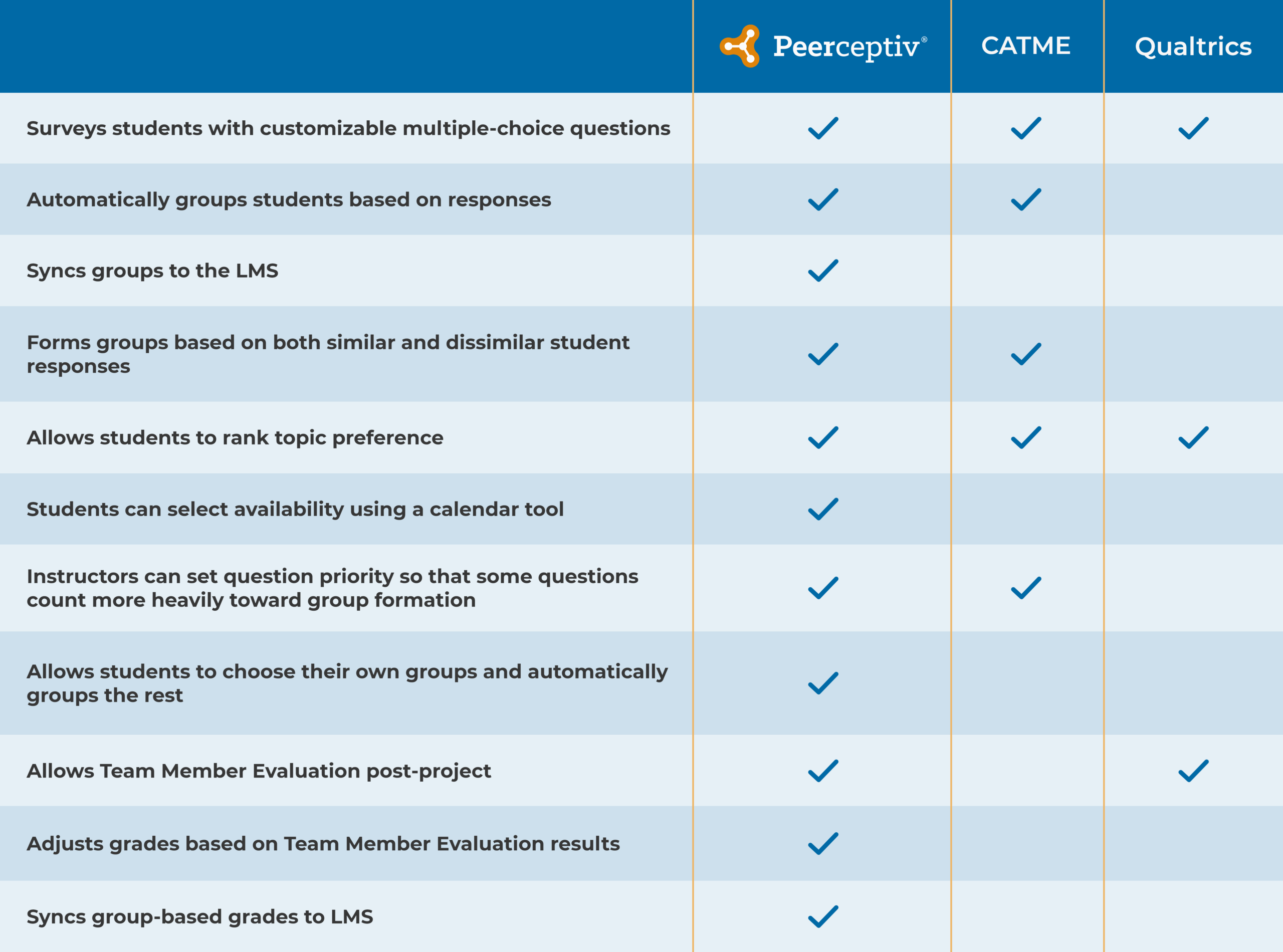
This chart breaks down the features that matter most to instructors and instructional designers—and shows why Peerceptiv has become the leading choice for forming effective student teams in higher education.
Why Peerceptiv Is the Best Group Formation Tool for Higher Ed
Peerceptiv is the only Group Formation tool that offers all of the following in one platform:
✔ Calendar-based availability matching
✔ Priority weighting for instructor-defined criteria
✔ Similarity + dissimilarity matching logic
✔ Customizable surveys to fit any course or assignment
✔ Modern UI that students understand immediately
✔ Seamless LMS integration (Canvas, Blackboard, D2L, Moodle)
✔ Automatic roster syncing
✔ Research-backed algorithm validated across thousands of courses
CATME overlaps with some features but lacks scheduling logic, a modern interface, and, crucially, LMS integrations.
Qualtrics is a powerful survey platform—but does not perform actual group formation using gathered criteria, and does not integrate with an LMS.
When Peerceptiv Is the Right Choice for Instructors
Peerceptiv is ideal if you teach:
- project-based courses
- labs with rotating teams
- writing-intensive courses with peer review
- interdisciplinary group assignments
- hybrid or online courses with scheduling challenges
FAQ: Group Formation Tools in Higher Education
- What is the best tool for forming student groups in higher education?
Peerceptiv is widely considered the best group formation tool for higher education because it is the only platform that combines customizable surveys, priority weighting, similarity/dissimilarity matching, demographic balancing, topic ranking, and calendar-based availability matching. CATME offers some overlapping features, and Qualtrics collects survey data, but neither provides the full group-formation logic needed to create balanced and schedule-compatible teams. - How does Peerceptiv form better groups than CATME or Qualtrics?
Peerceptiv uses a research-backed algorithm that accounts for academic skills, work style, availability, topic preference, and optional demographics. It also allows instructors to set which criteria matter most. Unlike CATME, Peerceptiv includes built-in calendar availability matching. Unlike Qualtrics, Peerceptiv actually creates groups rather than just collecting survey responses. - Can Peerceptiv integrate with Canvas or other LMS platforms?
Yes. Peerceptiv integrates with major learning management systems including Canvas, Blackboard, D2L Brightspace, and Moodle. LMS integration allows for automatic roster syncing and a seamless student-facing experience. - Can instructors customize the survey questions used to form groups?
Absolutely. Peerceptiv provides fully customizable questions so instructors can gather exactly the information they need—such as prior coursework, skill level, project interest, communication preferences, availability, and more. CATME offers limited customization, and Qualtrics requires significant manual setup. - Does Peerceptiv support similarity and dissimilarity in group formation?
Yes. Instructors can specify whether certain factors should be grouped by similarity (e.g., shared availability or project interest) or by dissimilarity (e.g., differing desired team roles). This flexibility is essential for project-based courses and is not supported in Qualtrics. - Is Peerceptiv easy for students to use?
Yes. Peerceptiv’s interface is modern, mobile-friendly, and designed for quick completion. - What types of courses benefit the most from Peerceptiv?
Peerceptiv is especially effective for project-based learning, capstones, lab courses, writing-intensive classes, interdisciplinary group work, and any course with substantial group collaboration. It is also ideal for large-enrollment courses where manual grouping is impractical. - How long does it take to set up group formation in Peerceptiv?
Most instructors can create and launch a group formation survey in under 10 minutes using Peerceptiv’s prebuilt question templates and simple workflow. LMS integration and roster syncing further reduce setup time. - Does Peerceptiv reduce the amount of manual work for instructors?
Yes. Peerceptiv automatically builds groups based on instructor-defined priorities and student data, eliminating the need to manually sort spreadsheets, adjust for scheduling conflicts, or rebalance teams later in the semester. - Is Peerceptiv research-backed?
Yes. Peerceptiv’s group formation and peer assessment algorithms are supported by nearly two decades of peer learning and educational measurement research, making it one of the most validated tools available for group formation in higher education.